The Green Steel system begins with four precision-engineered construction components, then layers in enterprise-grade Cisco networking, IoT automation, cybersecurity, and Dark Fiber connectivity — delivering buildings that are faster to build, stronger, more efficient, and genuinely intelligent.
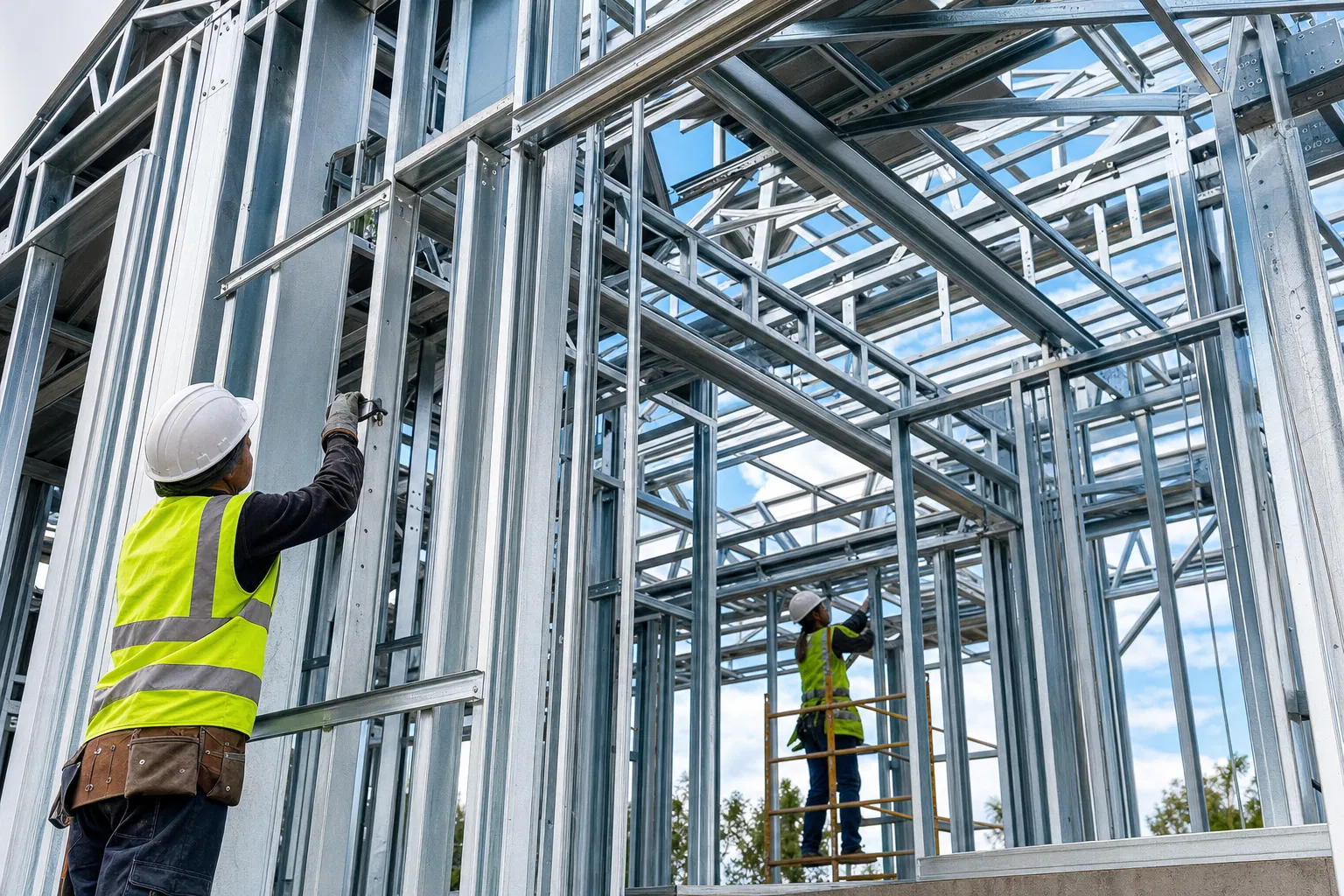
The structural backbone of every Green Steel building. Pre-engineered light gauge steel framing provides superior strength-to-weight ratio, dimensional stability, and complete resistance to rot, insects, and fire.
Unlike wood framing, steel never warps, shrinks, or expands with moisture changes — delivering a structure that maintains its precision tolerances for the life of the building.
Expanded Polystyrene (EPS) foam panels provide continuous, uninterrupted insulation with R-values far exceeding code minimums. The result: dramatically reduced heating and cooling loads throughout the building's lifetime.
EPS foam is inert, non-toxic, and completely resistant to moisture absorption — eliminating the conditions that allow mold to grow in conventional insulation materials.
Our proprietary non-toxic coating system is applied over the EPS foam panels to create a monolithic, seamless wall assembly. The coating bonds permanently to the substrate, creating a surface that is fire-resistant, impact-resistant, and completely waterproof.
The coating can be finished to any texture or appearance — from smooth stucco to exposed aggregate — making it suitable for any architectural style.
Every component is pre-engineered and pre-cut to specification before arriving on site. The result is a building system that can be assembled by a small crew in a fraction of the time required by conventional construction.
Reduced on-site labor, fewer skilled trades required, and dramatically shorter project timelines translate directly into lower construction costs and faster return on investment.
The numbers speak for themselves. Green Steel outperforms conventional construction in every measurable category.
| Category | Traditional Construction | Green Steel System | Advantage |
|---|---|---|---|
| Construction Speed | 12–18 months (typical) | 4–6 months | 3× Faster |
| Energy Efficiency | Standard code minimum | 60%+ above code | 60%+ Savings |
| Mold Resistance | High risk (wood/drywall) | Zero risk | Eliminated |
| Wind Resistance | 90–130 mph (code) | 200+ mph (Cat 5) | 2× Stronger |
| Fire Resistance | 1-hour rated (typical) | 4-hour rated | 4× Safer |
| Toxic Materials | VOCs, formaldehyde, fiberglass | Zero toxic materials | 100% Clean |
| Supply Chain Risk | High (lumber, drywall) | Minimal | Resilient |
Green Steel structures are built to last 200+ years. The technology inside them should be equally forward-looking. As a Cisco Certified Partner, we integrate enterprise-grade technology infrastructure into every build — transforming resilient structures into intelligent, connected environments.
Every Green Steel build is pre-wired for enterprise-grade Cisco networking. Structured cabling, Wi-Fi 6 access points, managed switching, and SD-WAN-ready routing are integrated during construction — not retrofitted afterward.
Physical resilience and digital security go hand in hand. Cisco's enterprise security stack — including next-generation firewalls, Umbrella DNS security, Duo zero-trust access, and SecureX threat response — is deployed as a standard component of every Green Steel build.
Smart IoT sensors and controllers are embedded throughout the structure during construction, enabling real-time optimization of HVAC, electrical loads, lighting, water systems, and access control — further compounding the 60%+ energy savings of the Green Steel envelope.
For mission-critical applications, Green Steel integrates dedicated dark fiber runs during construction — providing unmatched bandwidth, sub-millisecond latency, and complete data sovereignty with no shared infrastructure and no carrier dependency.
Unlike traditional construction where technology is an afterthought, Green Steel integrates Cisco enterprise infrastructure during the build phase — reducing retrofit costs, improving performance, and future-proofing every structure for decades of technology evolution.